 One of the biggest questions families ask us — and one of the biggest sources of stress — is simple: “What happens to everything during an estate cleanout?”
If you’ve inherited a home full of belongings, you know the feeling. It can be emotional. It can be overwhelming. And it can feel like you’re one bad decision away from either trashing something important or keeping so much that you can’t move forward.
So here’s the honest answer. Most homes contain a mix of value — financial value, sentimental value, and “useful‑to‑someone‑else” value. Our job is to uncover it, route it to the right place, and make the whole process easier on the family.
The short answer: we sort everything, then route it to the right next home
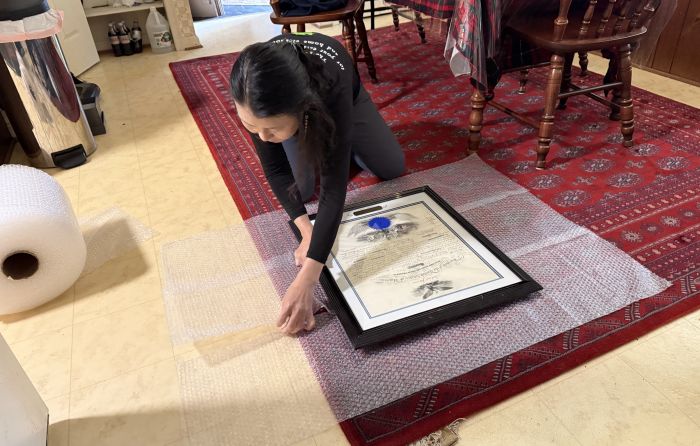
Our process starts the minute we arrive at a home. We immediately begin sorting all items on site. We use our 15 years and counting of valuation experience to sort items that will be sold, items that will go to auction houses, specialty dealers, and buyers, and at the same time we determine what items will go to charities, what will be recycled, and what truly has no choice but to go to a landfill.
Auction items are tagged with a special house ID so they are tracked and sold for that specific estate. While auction items are moving toward sale, we are simultaneously removing items that are going to charity. Then we provide the client with a comprehensive donation list and the tax receipt from the charity — saving them many hours of documentation work.
We also partner with a company that specializes in properly reusing and disposing of hazardous household chemicals like paints and paint thinners. These materials — often found in garages and basements — require specialized handling during estate cleanouts. We explain how the process works in detail in our article on household hazardous waste removal during estate cleanouts.
In other words, it’s literally one call that solves it all.
Sell: the hidden value is real (and it often looks like nothing)
People often assume they already know what is valuable in a home. In reality, value hides in plain sight. Some of the biggest surprises come from items that looked like donation or trash.
The beat‑up painting that sold for $5,000
We’ve told this story a lot because it captures the entire point. We took a beat‑up old painting that looked like donation or trash, but we had the experience to know we should send it to auction. It sold for $5,000.
The Walmart‑looking cover hiding a $10,000 chair
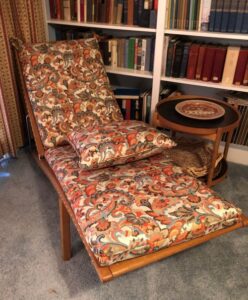
This Johannes Hansen Midcentury modern chair we sold years ago surprised everybody by selling for $10k.
In an upscale Washington, D.C., home, we found a chair with a new covering on it that looked like it came from Walmart — but the chair itself was Midcentury modern. We did our research and got auction estimates. The highest estimate was $2,000.
The chair sold for $10,000.
$125,000 in silver — and the $5,000 Coinstar near mistake
A Takoma Park, Maryland client knew he had inherited valuable silver — but he was still surprised when, after we charged $5,000 for the estate liquidation and cleanout, we sold his silver for $125,000.
Then came the second surprise. He had a jar of American coins he was about to drop into a grocery store change machine. He didn’t realize they were dimes, quarters, half‑dollars and dollars from 1964 and earlier — when coins were still made with silver. That would have been an incredibly costly mistake.
That jar sold for about $5,000. The client paid for the entire cost of the Montgomery County cleanout by letting us take the jar out of his hands before a grocery store machine could give him maybe $200.
What happens to everything during an estate cleanout? Sometimes, the answer is simple: it can make you far more money than you ever expected.
“It doesn’t cost you anything more… let us do our thing just to be sure.”
A woman battling hoarding and facing eviction told us we didn’t need to spend time going through her mother’s jewelry because it was all “junk jewelry.”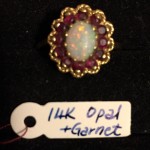
I kept telling her: “It doesn’t cost you anything more for us to take our time and go through it. Let us do our thing just to be sure.”
She was floored when we reported we found fine jewelry that sold for $16,000 — and another $2,200 from the rest.
Donate: we get items to the right charities — and document it
Donation is a huge part of keeping usable items out of the landfill. As we work, we designate what goes to which charities, remove those items, and provide the client with a comprehensive donation list and the tax donation receipt.
We work extensively with nonprofits including Community Forklift. Check out this story about how donating refrigerators there can save lives. We love A Wider Circle. We also do everything we can to help animals at the Montgomery County Humane Society, and House With a Heart Senior Pet Sanctuary.
We even donate unexpired food — something that’s easy to overlook — thanks to a food pantry right by our house.
Landfill avoidance: creative solutions that save money and reduce waste
The FREE yard sale that solved a big problem
The key to liquidating the estate of a U.S. government official? Conducting a FREE yard sale while we were performing the rest of the work.
There were tons of objects charities typically don’t take, and it would have cost the family a fortune for us to drive all over the DMV finding homes for them. We loaded up plenty of good stuff to take away and sell, took tons to charity, and gave away an entire large front yard full of other usable items.
The Magic Monarch
 We took a fiberglass boat that was no longer seaworthy and very expensive to dispose of. We brought it back to our own house and upcycled it into “The Magic Monarch” — a monarch butterfly waystation for a threatened species.
The boat fit naturally with what we were already doing — replacing useless lawn grass with wildlife habitat.
The human side of this work
We tend to see two types of clients. Some want the house cleared quickly so they can move on. Others feel deeply sentimental and overwhelmed. We’re gentle with both.
We suggest taking photos of meaningful items, keeping one item from collections, and remembering loved ones would want families happy — not burdened by too much stuff.
Clients often tell us within the first 30 minutes they are glad they hired us because we find things other companies miss. We’ve had people break down in tears when we found a mother’s wedding dress buried under piles of belongings.
And yes — sometimes the work gets weird. Years ago, some of our toughest teenage crew members jumped onto a couch squealing when a white rat with pink eyes stared up at them. We laughed … and got back to work.
Our philosophy on waste and reuse
It’s hard to talk about waste without getting philosophical. We believe there is value in most things. Even if something doesn’t have resale value, many objects deserve a second life. Helping items find new homes is practical, environmental, and even spiritual work.
We’ve seen this philosophy play out in ways most people wouldn’t expect.
In one case, it even involved a cement pig “rescue” — a situation that perfectly captured how unpredictable these homes can be, and how committed we are to handling everything thoughtfully rather than just throwing things away.
You can read that full story here.
Need Help With an Estate Liquidation and Home Cleanout?
Contact Orion’s Attic today to learn how we can make the process easier. Be sure to check out our YouTube channel at Orion’s Attic TV, too.
Learn more about liquidating estates in our Estate Liquidation and Downsizing Guide.
About Orion’s Attic
Orion’s Attic is a full-service estate liquidation, downsizing and home cleanout company based in Silver Spring, Maryland. We also buy antiques, collectibles, gold, silver, fine jewelry, and sterling silver. Now in our 15th year in business, Orion’s Attic completes more than 100 full-home estate liquidation and cleanout projects each year — working on-site nearly every weekday. We serve Montgomery County (Bethesda, Chevy Chase, Gaithersburg, Germantown, Olney, Potomac, Rockville, Silver Spring, Takoma Park, Wheaton, etc.), Baltimore County, Frederick County, Howard County, Prince George’s County, and the greater metro Washington D.C., Maryland, Northern Virginia area.